Introduction: the unseen footprint of traditional product development
On World Environment Day, most conversations focus on forests, oceans, and energy. But there is another area where choices matter: how we build software.
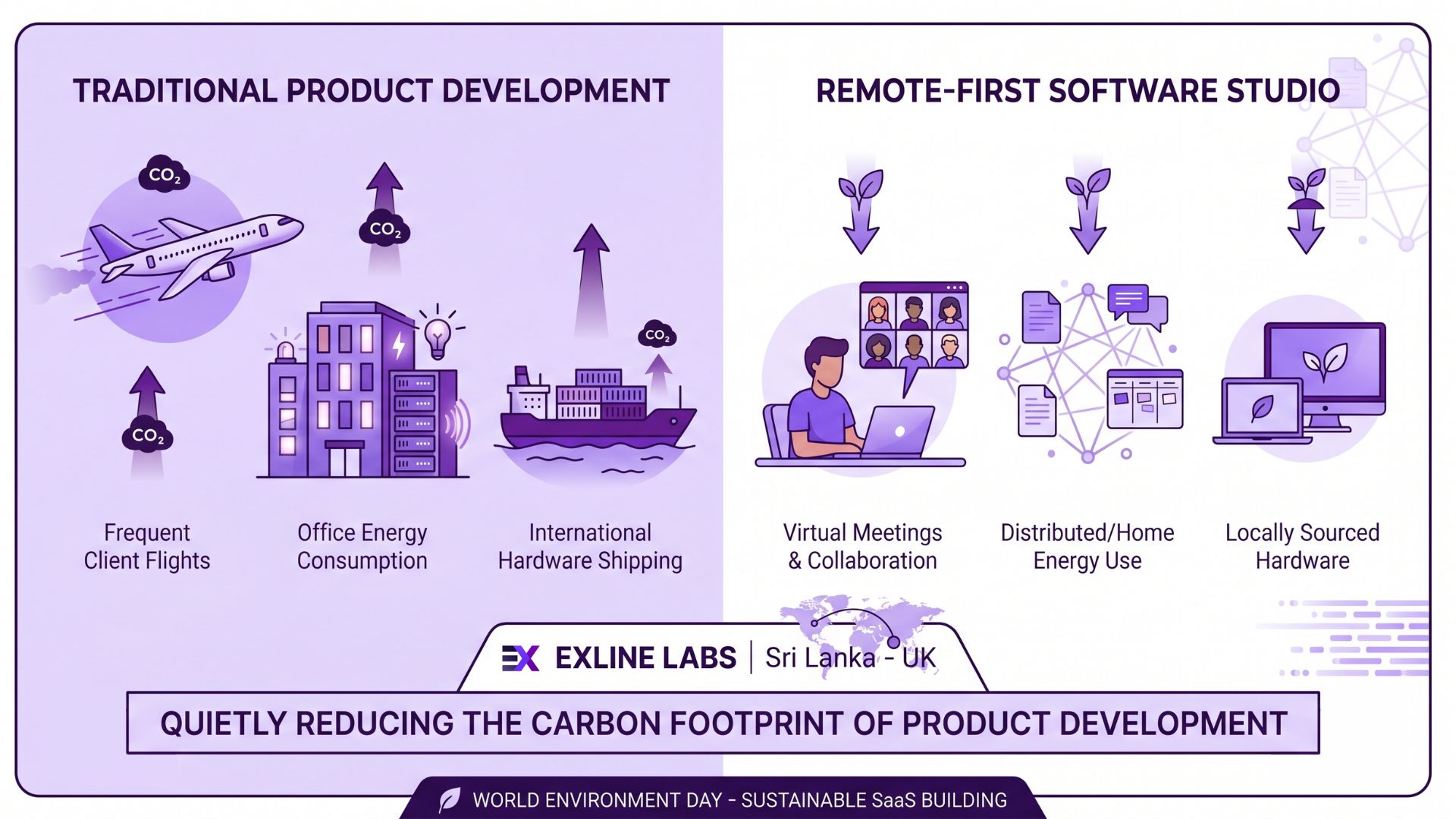
Founders usually think about speed, cost, and talent when choosing a partner for product development. What is rarely discussed is the environmental impact. Traditional agencies rely on flights for client meetings, office energy consumption, and hardware shipped internationally. Each of these adds to the carbon footprint.
Remote‑first software studios show a different path. By working fully distributed, they cut out the waste. At Exline Labs, our team in Sri Lanka delivers to clients in the UK without flights, without office overhead, and without unnecessary shipping. The result is a lighter footprint and a cleaner way to build software.
No flights for client meetings
Air travel is one of the largest contributors to carbon emissions. A single London‑Colombo round trip can exceed 2 tons of CO₂ per passenger. Multiply that by quarterly workshops or annual reviews, and the footprint grows quickly.
Remote‑first software studios remove this entirely. Meetings happen over video calls. Workshops run asynchronously. Collaboration is real, but the emissions are not. For founders, this means progress without the guilt of unnecessary travel.
On World Environment Day, the message is clear: every avoided flight is a step toward balance.
No office energy consumption
Agencies often operate large offices with heating, cooling, and lighting running all day. Servers hum in the background. Screens stay long after staff leave. Remote‑first studios to avoid this. Teams work from home or co‑working spaces with shared energy use.
The difference is measurable. A distributed studio does not carry the overhead of powering a building just to keep staff together. At Exline Labs, our footprint is limited to the energy our team uses individually, not the inflated consumption of a corporate office.
Reducing office energy is like reducing deforestation. It cuts unnecessary demand and preserves resources.
No hardware shipped internationally
Traditional agencies often ship laptops or servers across borders. Remote‑first studios rely on local sourcing. At Exline Labs, our Sri Lanka team uses locally purchased hardware. Nothing is flown in. Nothing is shipped out.
This small change avoids unnecessary transport emissions. It also supports local suppliers. The environmental benefit is clear, but the economic benefit is equally important.
On World Environment Day, this matters. Every shipment avoided is one less strain on the global supply chain.
Async‑first communication reduces unnecessary travel
The biggest hidden footprint in product development is travel. Agencies often fly to staff for workshops or client reviews. Remote‑first studios design communication to be async‑first. Documentation, recorded demos, and shared boards replace physical presence.
This reduces travel demand and keeps collaboration efficient. At Exline Labs, we run design sprints asynchronously. Clients in the UK review prototypes overnight while our Sri Lanka team prepares the next iteration. No one travels. Everyone progresses.
Async communication is like renewable energy. It replaces heavy consumption with lighter, smarter practices.
Grounding in Exline Labs reality
We are not talking theory. Exline Labs runs this model every day. Our Sri Lanka team delivers fully digital projects for UK clients. No flights. No office. No shipping. Every project is proof that product development can be both effective and environmentally responsible.
One example: a SaaS client in London needed a full UX audit and redesign. Traditionally, this would have meant flying a team in, booking meeting rooms, and printing materials. Instead, we ran the audit remotely. Analytics were shared digitally. Session recordings were reviewed asynchronously. Recommendations were delivered in a structured report. The client received everything they needed without a single mile of travel.
This is our contribution to World Environment Day: Proving that software can be built without harming the planet.
Why this matters for founders
Founders are under pressure to show responsibility. Investors, customers, and employees care about sustainability. Choosing a remote‑first studio is not just a cost or speed decision. It is an environmental choice. It shows that you are building responsibly, not just building fast.
A study from Profit Well found that companies focusing on sustainable practices saw higher retention among both customers and staff. Responsibility builds trust. Trust builds loyalty.
On World Environment Day, responsibility is not optional. It is expected.
The bigger picture: digital delivery as climate action
The environmental case for remote‑first studios is not about perfection. It is about reductions. Every avoided flight, every unused office, every locally sourced laptop is a step toward lower emissions.
Software may seem intangible, but the way it is built has a footprint. By choosing remote‑first studios, founders reduce that footprint. They align product development with climate responsibility.
World Environment Day reminds us that small changes matter. Remote‑first delivery is one of those changes.
In Conclusion
The environmental case for remote‑first studios is clear. No flights. No office energy. No hardware shipping. Async communication instead of travelling. Each of these reduces the carbon footprint of product development.
At Exline Labs, we believe building software should not come at the expense of the planet. Our Sri Lanka team delivers fully digital projects for UK clients, proving that remote‑first is not just practical, it is responsible.
On World Environment Day, we celebrate balance. Just as ecosystems thrive when waste is reduced, SaaS products thrive when development is clean, efficient, and responsible.


